Master the Big 4
Prepare one clear logic block for self-cognition, school fit, social awareness, and situational judgement instead of memorising hundreds of separate answers.
Hong Kong Secondary Interview Preparation
Secondary Interview Handbook
Hong Kong Secondary Schools
A calm, structured reading experience for students preparing for Hong Kong secondary school interviews, now revised around the Big 4 themes, reusable answer frameworks, and more natural speaking logic.
Preparation frame
60 questions
Rebuilt around self-cognition, school fit, social awareness, and situational judgement.
Focus
Logic, tone, and authentic delivery
Method
Frameworks instead of memorised scripts
Reminder
Strong candidates answer clearly, support the point, and still sound like themselves.
Orientation
This revision moves away from memorising isolated answers and instead trains students to recognise patterns. The question bank is now aligned to the Big 4 categories, and every answer is written in a way that models a reusable structure. The goal is to help students sound calm, logical, and genuine even when the exact question changes.
Treat the model answers as flexible logic blocks. Practise the structure, then swap in your own examples, wording, and tone.
Prepare one clear logic block for self-cognition, school fit, social awareness, and situational judgement instead of memorising hundreds of separate answers.
Build answers with 1 + 2 Step, Golden Three Points, or REFL / STAR so you sound organised, flexible, and natural under pressure.
Keep examples consistent with family answers, breathe before difficult questions, and avoid sounding over-rehearsed or robotic.
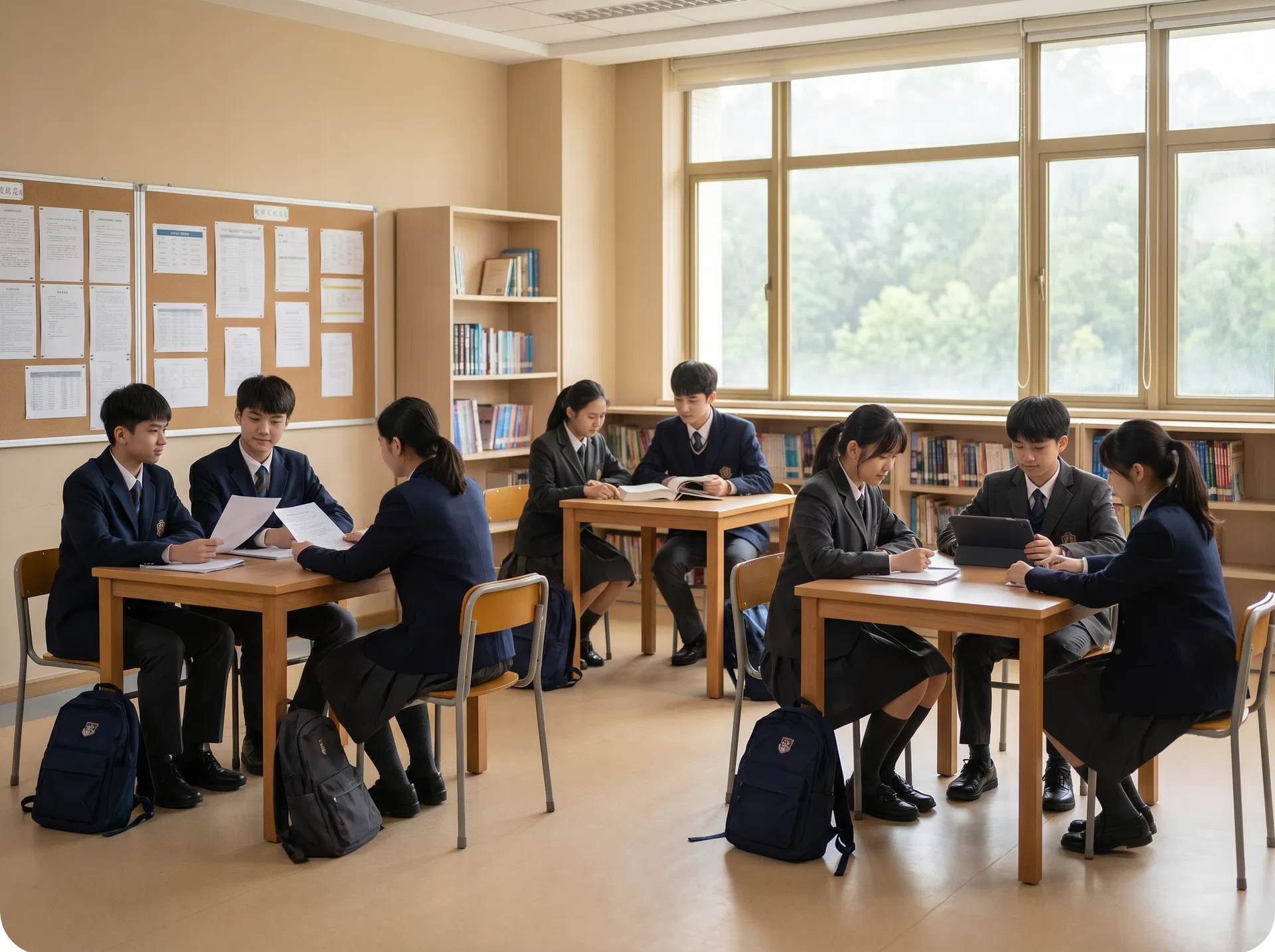
Framework thinking
The strongest preparation is concise. Instead of trying to remember hundreds of perfect lines, students should prepare a small number of personal examples and learn how to rebuild them across different question types.
Pick two strong personal traits and one achievement you can explain from different angles.
Use students, teachers, and facilities or curriculum when answering school-fit questions.
For tricky issues, show both sides first, then state your own balanced view.
The Big 4
Choose two anchor traits, such as perseverance and curiosity, plus one achievement you can reuse naturally.
Use the 3D dimension approach: students, teachers, and facilities or curriculum.
Show both sides first, then give your own balanced position with one practical example.
Let integrity, communication, and empathy guide the answer before you explain action steps.
Universal frameworks
| Technique | When to use |
|---|---|
| 1 + 2 Step | Best for general questions. Give one direct answer, then add two supporting details such as a reason and an example. |
| Golden Three Points | Best for social issues or policy topics. Organise ideas as firstly, secondly, and thirdly, each with short evidence. |
| REFL / STAR | Best for challenges and personal stories. Explain the situation, your action, your feeling or thinking, and the lesson or result. |
Concise preparation strategies
Interview performance is not only about content. It is also about memory, calmness, consistency, and whether a student sounds like a real person instead of a recording.
| Practice focus | How to use it |
|---|---|
| Portfolio file | Group your examples into Academic, Music, Sport, and Service so you can recall evidence quickly during the interview. |
| 4-7-8 breathing | Inhale for 4 seconds, hold for 7, and exhale for 8 when you meet a tricky question and need to reset. |
| Avoid canned answers | Practise frameworks with different topics instead of memorising one fixed speech word for word. |
| Keep family answers consistent | If parents are interviewed, make sure descriptions of habits, homework, and phone use do not contradict one another. |
Quick reset
Inhale for 4 seconds, hold for 7 seconds, and exhale for 8 seconds. Use it before a difficult answer so your pace slows down and your thinking becomes clearer.
If an answer sounds too polished, interviewers may ask more follow-up questions to test whether it is real. Practise structure and examples, but leave room for natural wording.
Publicly discussed styles
These questions reflect publicly discussed interview styles. The answers below are rewritten to sound more structured, balanced, and adaptable rather than memorised.
Suggested answer
I would most like to meet Dr. Sun Yat-sen. First, I admire his perseverance because he continued working for change even when success was not immediate. Second, I would like to learn how he stayed calm and committed under pressure. I think meeting someone like him would remind me that strong character matters as much as talent.
Suggested answer
I think it can help, but it should not be the only solution. Firstly, a higher charge may stop some people from using emergency services for small problems. Secondly, some people may still misuse the service because they do not know where else to go. Thirdly, if the charge is too high, some families may delay necessary treatment. So my view is that the fee may help a little, but education and better primary care are also necessary.
Suggested answer
I think the exact number is mainly a policy balance. Firstly, it must be high enough to make people think carefully before using the service unnecessarily. Secondly, it cannot be so high that ordinary citizens feel blocked from urgent care. Thirdly, the government also needs to consider fairness and administrative practicality. So I would say the number is probably chosen as a compromise rather than because one amount is perfect.
Suggested answer
I would prepare in three areas. Firstly, I need strong academic foundations, especially languages, analysis, and current affairs. Secondly, I need character, such as honesty, courage, and a sense of justice. Thirdly, I need communication and observation skills because investigators must work carefully with people and evidence. I know it is a long-term goal, but I can start building these qualities now.
Suggested answer
Yes, but it should be moderate and meaningful. Firstly, some homework helps students keep regular learning habits. Secondly, holidays should still leave room for rest, reading, and family time. Thirdly, quality matters more than quantity, so short revision or independent reading is better than heavy drilling. In my view, holiday homework is useful when it supports balance rather than pressure.
Suggested answer
I would try to open the discussion in a calm and friendly way. First, I would ask simple questions so quieter classmates can join more easily. Second, I would encourage different opinions instead of letting only one person speak. I think good discussion is not about dominating others but helping everyone feel safe enough to contribute.
Big 4 · Self-Cognition
These answers are built around a few reusable traits, usually perseverance, curiosity, responsibility, and reflection. The aim is to sound clear and genuine, not over-prepared.
Suggested answer
Good morning, Principal and teachers. My name is Raymond Chan, and I am a Primary Six student who is curious, responsible, and willing to improve. I especially enjoy English and Science because I like expressing ideas clearly and understanding how things work. Outside class, I enjoy reading, swimming, and group activities, and these experiences have helped me become more disciplined and more confident when working with others.
Suggested answer
I think you should choose me because I have a good learning attitude. First, I am willing to work steadily even when something is difficult, so I do not give up easily. Second, I try to contribute positively to the people around me by being responsible and cooperative. I may still have room to improve, but I am the kind of student who listens, reflects, and grows.
Suggested answer
My main strengths are perseverance and curiosity. Perseverance helps me keep working when the result does not come quickly, especially in subjects that need practice. Curiosity helps me ask questions and learn beyond the minimum requirement. I think these two qualities are useful because they support both academic growth and personal growth.
Suggested answer
One weakness I am improving is that I can become nervous when speaking in front of many people. I have started dealing with this by volunteering more in class and preparing short speaking points before presentations. I am still improving, but I think the important thing is that I do not avoid the weakness anymore.
Suggested answer
My favourite subject is English. First, it helps me communicate with different people and understand more of the world. Second, I enjoy the feeling of becoming more precise when I speak or write. Because I am curious and like expressing ideas clearly, English feels both useful and enjoyable to me.
Suggested answer
Chinese writing is more challenging for me because I need extra time to organise my ideas well. To improve, I read model essays and keep useful expressions, and I also ask teachers for feedback after practice. This has taught me that improvement often comes from patient revision rather than quick results.
Suggested answer
I join swimming and service activities. Swimming teaches me discipline because progress depends on regular practice, not only talent. Service activities teach me empathy because they remind me to notice other people’s needs. Together, these activities help me grow both in persistence and in character.
Suggested answer
During a class project, my group had many ideas but no clear direction, so we were losing time. I suggested that we list the ideas first, then divide the work according to each member’s strength. After that, the group became more organised and finished on time. This experience taught me that leadership is not about being the loudest person, but about helping a team move forward calmly.
Suggested answer
I manage my time by setting priorities. First, I finish important homework or revision before entertainment. Second, I keep a simple order for tasks so I do not waste time deciding what to do next. This habit helps me feel more organised and also reduces stress before tests.
Suggested answer
When I make a mistake, I first admit it honestly instead of hiding it. Then I try to understand why it happened and what I can change next time. For example, if I forget something important, I adjust my routine rather than only saying sorry. I think mistakes become valuable when they lead to better habits.
Suggested answer
My mother has influenced me most. First, she shows me what responsibility looks like because she handles daily duties steadily without complaining. Second, she reminds me that progress comes from regular effort, not from luck alone. Because of her, I understand that character and discipline support success.
Suggested answer
In my free time, I enjoy reading and swimming. Reading satisfies my curiosity because it lets me explore ideas beyond the classroom. Swimming helps me stay disciplined and calm because improvement comes through steady practice. I think these hobbies balance my mind and my routine.
Suggested answer
One achievement I am proud of was improving my English presentation score after I had once spoken too softly in class. I prepared more carefully, practised aloud at home, and asked my teacher for advice on voice and pacing. The next time, I spoke more clearly and felt much more confident. I was proud not only of the result, but of the fact that I improved through effort.
Suggested answer
I want to become a student who is mature, dependable, and open to challenge. First, I hope to be dependable in study and in teamwork. Second, I want to become more confident in communication while keeping a respectful attitude. To me, growth in secondary school should include both achievement and character.
Big 4 · School Fit
These answers use the 3D dimension approach: students, teachers, and facilities or curriculum. They are designed to sound informed but not overly scripted.
Suggested answer
I want to study at this school for three reasons. Firstly, the students here seem active and serious about learning, and I want to grow in that environment. Secondly, I believe the teachers can guide students not only academically but also in character. Thirdly, the school’s curriculum and activities seem to support all-round growth, which matches what I want from secondary school.
Suggested answer
From what I have learned, your school stands out in three ways. Firstly, it values more than examination results, because character and discipline are also important. Secondly, students are encouraged to participate actively and communicate well. Thirdly, the learning environment seems structured but still supportive, which is important for students who want to grow steadily.
Suggested answer
This school can help me in three areas. Firstly, it can strengthen my academic foundation, especially in language and independent learning. Secondly, it can help me grow through teacher guidance and a disciplined environment. Thirdly, activities and school life can help me discover strengths beyond the classroom. That is why I see the school as a place for long-term development, not only short-term results.
Suggested answer
I would like to contribute in three practical ways. Firstly, I would contribute through attitude by being responsible, punctual, and respectful. Secondly, I would contribute to class life by cooperating well and supporting classmates when needed. Thirdly, I would join activities or service where I can represent the school positively. I think contribution begins with small daily actions, not only big achievements.
Suggested answer
I am most looking forward to broader learning and greater independence. First, I want to explore more subjects and activities than I had in primary school. Second, I want to learn how to manage my work and responsibilities more maturely. I think secondary school is exciting because it gives students more chances to grow.
Suggested answer
At the moment, I am interested in becoming an engineer. First, I enjoy solving problems and understanding how systems work. Second, I like the idea of doing practical work that can improve daily life for other people. Even if my future job changes later, I know that curiosity and discipline will still be important.
Suggested answer
Yes. I want you to know that I may not be perfect, but I am serious about improvement. First, I am willing to learn from feedback instead of becoming defensive. Second, I try to stay dependable in both study and teamwork. I believe this attitude will help me adapt well and contribute steadily to the school.
Suggested answer
I feel positive about it because higher expectations can help students grow. First, they push me to organise myself better and work harder. Second, they can help me develop resilience when I face difficulty. I know the transition may be challenging at first, but I am willing to adjust and learn.
Suggested answer
I can adapt by staying open-minded and organised. First, I will listen carefully to school expectations and manage my routine well. Second, I will try to speak with new classmates and ask teachers for help when necessary. I think adaptation becomes easier when attitude and action go together.
Suggested answer
To me, independence means taking responsibility for my work and daily habits. First, it means trying my best before depending on others immediately. Second, it means asking for help in a mature way when it is truly needed. So independence is not about doing everything alone, but about being accountable.
Suggested answer
I learn best in a class atmosphere that is focused but encouraging. First, students should respect the teacher and take learning seriously. Second, classmates should still feel comfortable asking questions and sharing ideas. I think the best learning environment combines discipline with support.
Suggested answer
I would set three goals for my first year. Firstly, I want to build stable study habits and adapt to the faster pace. Secondly, I want to improve my English speaking and confidence. Thirdly, I want to join at least one activity or service role so I can grow beyond academic work. These goals would help me develop in a balanced way.
Big 4 · Situational Ethics
These answers begin with values first: integrity, communication, empathy, and responsibility. After that, they move to practical action.
Suggested answer
I handle disagreement through respect and communication. First, I listen carefully because some conflicts happen only because of misunderstanding. Second, I explain my view calmly and try to find a fair solution. I think disagreement can become constructive if people focus on solving the problem rather than winning.
Suggested answer
I would not ignore it. First, I would support the classmate and, if it was safe, tell the bully to stop. Second, I would report the situation to a teacher quickly because bullying needs proper adult handling. I think empathy and responsibility are both necessary in that situation.
Suggested answer
I would live peacefully by respecting differences and communicating early. First, I would remember that not everyone has the same habits or preferences. Second, if something affects shared space or work, I would discuss it politely instead of becoming annoyed in silence. I think small conflicts are easier to solve when people stay respectful.
Suggested answer
When I feel stressed, I try to calm myself first and then solve the problem step by step. First, I may take a short pause and use breathing or quiet thinking to settle down. Second, I organise what I can do and ask for help if the problem is bigger than I can handle alone. I think maturity means facing pressure honestly instead of pretending it does not exist.
Suggested answer
I would refuse because honesty is more important than convenience. First, copying is unfair and does not help my friend really learn. Second, I would still try to help in the right way, such as explaining the question or encouraging him to ask the teacher. A real friend should support learning, not cheating.
Suggested answer
If I forgot an important assignment, I would tell the teacher honestly as soon as possible. Then I would apologise, submit it quickly, and change my routine so it does not happen again, for example by checking deadlines more carefully. I think responsibility means correcting the mistake, not only admitting it.
Suggested answer
I would lead mainly by example and calm communication. First, I would be punctual, respectful, and serious about my own duties. Second, I would remind classmates politely instead of acting bossy. If a problem continued, I would ask the teacher for guidance because leadership should be firm but fair.
Suggested answer
If that happened, I would first stay calm because panic would waste time. Then I would help the group focus on the most important tasks, divide the work clearly, and support weaker members if needed. After finishing, I would reflect on what caused the problem so we could work better next time. A difficult situation should bring out teamwork, not blame.
Suggested answer
I would try to include the classmate. First, I would speak to him or her and invite the person to join us if appropriate. Second, I would make sure the person feels welcomed instead of treated like a burden. Small acts of inclusion matter because school should feel safe and respectful.
Suggested answer
I would feel disappointed, but I would not let one test define me. I would review what went wrong, ask for advice, and adjust my study method instead of only feeling upset. Then I would use the result as motivation for the next test. I think resilience is shown in how we respond after failure.
Suggested answer
I would try to accept it with a learning attitude. First, I would listen carefully instead of reacting emotionally immediately. Second, I would use the feedback to improve the next piece of work. Criticism can be uncomfortable, but it is valuable if it helps me grow.
Suggested answer
I would refuse politely because friendship should not replace integrity. First, rules usually exist to protect fairness or safety. Second, if I followed my friend just to avoid awkwardness, both of us might face bigger consequences later. So I would stand by what is right while still speaking respectfully.
Suggested answer
I would rebalance my schedule. First, I would identify which activities matter most and which ones I cannot manage responsibly at the moment. Second, I would protect enough time for schoolwork and rest. I think maturity means knowing that saying no can sometimes be a wise decision.
Suggested answer
I would focus on the task and stay professional. First, I would treat the person respectfully even if we were not close. Second, I would communicate clearly and divide work fairly so personal feelings do not damage the group result. In school, maturity means cooperating well even when it is not easy.
Big 4 · Social Awareness
Social awareness, technology, and opinion questions
These answers use a two-sided perspective. They begin by showing awareness of both benefits and risks, then move toward a calm personal judgment.
Should students be allowed to use mobile phones freely in school?
Suggested answer
I do not think students should use mobile phones freely in school. Firstly, phones can support learning and communication when used properly. Secondly, they can also distract students and reduce face-to-face interaction. Thirdly, schools need a fair and clear environment, so rules should guide when and how phones are used. My view is that phones should be limited, not fully banned or fully free.
Is winning more important than teamwork?
Suggested answer
I do not think winning is more important than teamwork. Firstly, teamwork teaches trust and responsibility, which are valuable beyond one competition. Secondly, a team that only cares about winning may damage relationships and lose respect. Thirdly, good teamwork often leads to better results anyway. So I believe teamwork is the stronger foundation.
Should students do community service?
Suggested answer
Yes, I think students should do community service. Firstly, it helps students understand the needs of different people in society. Secondly, it develops humility and responsibility instead of only focusing on ourselves. Thirdly, service can also improve communication and teamwork. That is why I think it is an important part of education.
Which is more important: being smart or being kind?
Suggested answer
If I must choose one, I would say being kind is more important. Firstly, intelligence is useful, but it can be used badly without good values. Secondly, kindness helps build trust and healthy relationships. Thirdly, a kind person who keeps learning can still become capable over time. So I think kindness is the stronger base for long-term success.
Do you think stricter rules help students grow?
Suggested answer
I think rules help students grow when they are reasonable. Firstly, clear rules create order and fairness. Secondly, they teach responsibility and self-control. Thirdly, students learn better when they understand not only the rule, but also the reason behind it. So I support firm rules with clear explanation rather than strictness for its own sake.
What makes a good classmate?
Suggested answer
A good classmate is respectful and dependable. First, he or she should cooperate well and not make fun of others. Second, a good classmate helps create a positive atmosphere where people can learn without fear. I think classmates shape school life every day, not only teachers.
Should schools give students more project work and less testing?
Suggested answer
I think schools should keep a balance. Firstly, tests are useful for checking knowledge and helping students revise seriously. Secondly, project work develops teamwork, creativity, and communication. Thirdly, different students show strength in different formats, so a balanced system is fairer. In my view, schools should use both, not choose only one.
Is it better to be a leader or a team member?
Suggested answer
I think both roles are important. First, leaders help a group move in the right direction. Second, team members make success possible through support, responsibility, and cooperation. I believe students should learn how to do both because different situations need different roles.
Should schools start later in the morning?
Suggested answer
I think it is worth considering carefully. Firstly, more sleep may help students concentrate and stay healthier. Secondly, a later start could create transport or family schedule problems. Thirdly, school discipline and study habits still matter even if the start time changes. So I would support a later start only if it is practical for students and families.
Which is more important for success: talent or hard work?
Suggested answer
I think hard work is more important. Firstly, talent may give a faster beginning, but effort decides whether improvement continues. Secondly, hard work helps people overcome weak areas. Thirdly, effort also builds habits such as discipline and patience, which are useful in every subject. So my position is that talent helps, but hard work carries people further.
Should students always follow the majority opinion in group discussions?
Suggested answer
No, students should listen to the majority but not follow it blindly. Firstly, majority opinion can be useful because it may reflect practical agreement. Secondly, a minority opinion may still improve the final idea if it has good reasoning. Thirdly, respectful discussion should focus on quality of ideas, not only numbers. So I think students should think independently while remaining cooperative.
What is more important in school life: academic results or character?
Suggested answer
I think character is more fundamental. Firstly, academic results open opportunities, but character influences how a person uses them. Secondly, good character supports habits like honesty, discipline, and persistence, which also improve results. Thirdly, schools are preparing students for life, not only examinations. So both matter, but character is the stronger foundation.
Do you think AI is helpful for students?
Suggested answer
Yes, AI can be helpful if students use it wisely. Firstly, it can explain difficult ideas and make learning more efficient. Secondly, if students depend on it too much, they may stop thinking for themselves. Thirdly, schools should teach students how to use AI ethically instead of simply fearing it. My view is that AI should support learning, not replace effort.
How should young people respond to problems like an ageing population in Hong Kong?
Suggested answer
Young people can respond in practical ways. Firstly, we should develop empathy and respect for older people in daily life. Secondly, we can join service and learn more about the social needs of the elderly. Thirdly, as future citizens, we should care about long-term issues such as healthcare, community support, and responsible use of technology. Even if we are young now, awareness should start early.